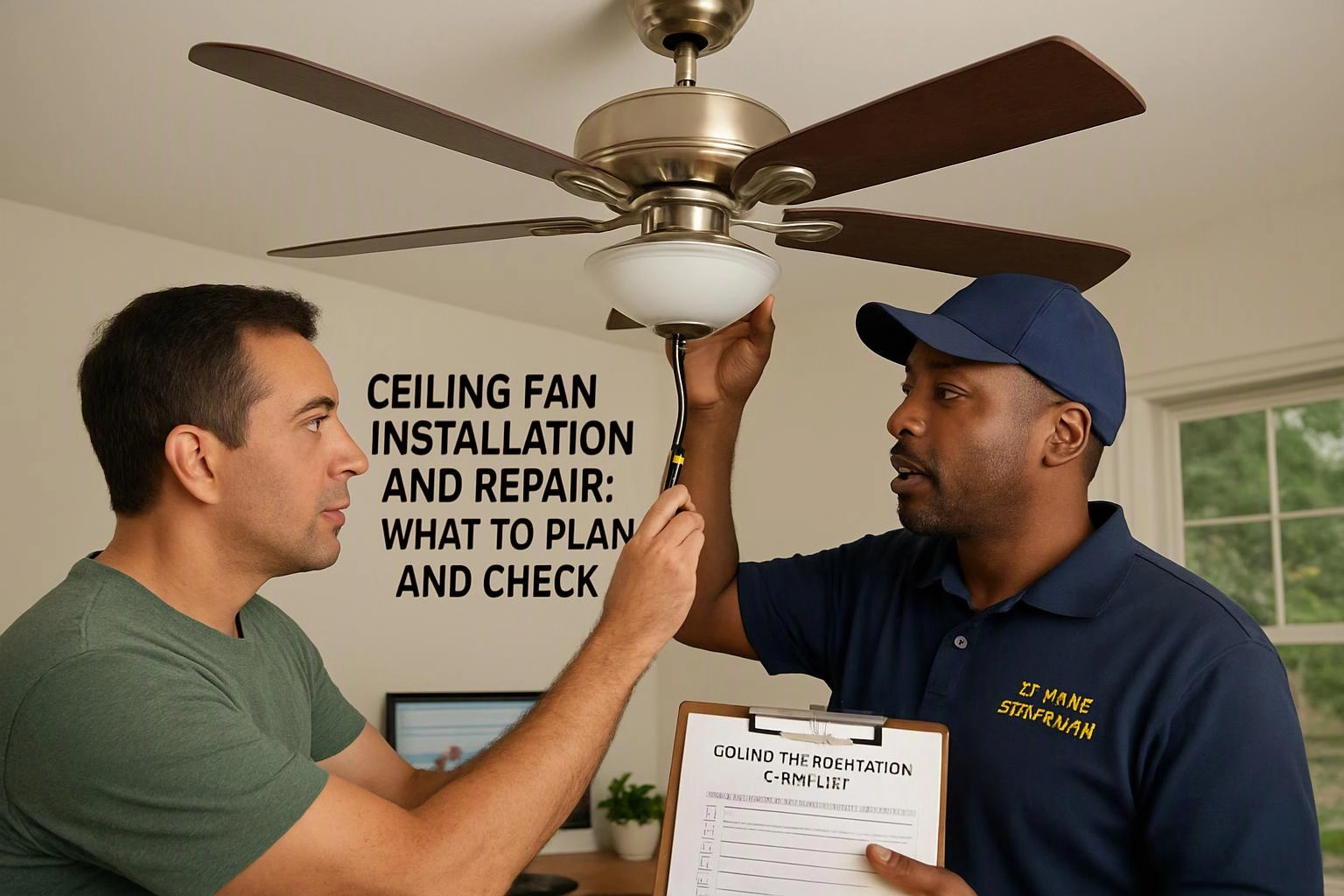
Ceiling Fan Installation and Repair: What to Plan and Check
Ceiling fan installation and repair require a secure mount, compatible wiring, safe electrical connections, balanced operation, and functional controls; Toledo Electrician checks these conditions and handles the work when the job exceeds safe DIY checks.
Get a Free EstimateOptions at a Glance
Ceiling fan installation and ceiling fan repair solve different problems. The right choice depends on whether the room needs a new setup or an existing fan has a clear fault.
- Ceiling fan installation: Best for a new fan, replacement fan, or room without suitable support and controls.
- Ceiling fan repair: Best for a fan with a known wobble, noise, control, light, wiring, or mounting problem.
What Should You Check Before Installing a Ceiling Fan?
Ceiling fan installation should begin with checking the ceiling structure, electrical box, wiring, fan compatibility, controls, and safe access.
The ceiling structure must support the fan and its movement. We inspect the electrical box, existing electrical wiring, mounting point, ceiling height, and room layout before selecting the fan location.
Fan size, wall switch wiring, and remote control options must work together. We also confirm that the electrical box and support brace are suitable for the fan assembly.
For a planned new setup, our team can complete Ceiling Fan Installation with the mounting and control checks included.
Ceiling Fan Installation or Repair: Which Service Fits the Job?
Ceiling fan installation fits a new or replacement fan, while ceiling fan repair fits an existing fan with a specific operating, electrical, or mounting problem.
| Factor | Ceiling Fan Installation | Ceiling Fan Repair |
|---|---|---|
| Cost drivers | Fan, wiring, ceiling access, support, and controls | Diagnosis, repair complexity, access, and replacement parts |
| Work scope | Mounting, wiring, controls, and functional testing | Fault finding, component service, connection checks, and testing |
| Maintenance | Follow the fan maker's care instructions | Correct the cause and inspect related parts |
| Best for | A new or replacement fan setup | An existing fan with a repairable fault |
Installation usually involves broader mounting and wiring work. Repair focuses on diagnosis and the parts connected to the reported symptom.
What Are the Advantages of Ceiling Fan Installation?
Ceiling fan installation provides a planned fan location, compatible support, and working controls when the existing setup does not meet the room's needs.
Best for: rooms without a suitable fan or homeowners replacing an outdated or incompatible unit.
What Are the Advantages of Ceiling Fan Repair?
Ceiling fan repair addresses a known fault while preserving the existing fan when its mounting, wiring, motor, controls, or components can be safely serviced.
Best for: an existing fan with a repairable symptom such as wobbling, unusual noise, failed controls, or inconsistent operation.
How Do You Complete a Ceiling Fan Installation Checklist?
Ceiling fan installation follows a safety, mounting, wiring, control, and operating sequence. We use the checklist to connect each installation task to a final functional test.
What Signs Mean a Ceiling Fan May Need Repair?
Ceiling fan repair may be needed when a fan wobbles, makes unusual noise, runs inconsistently, loses light or control functions, or shows signs of an electrical fault.
Wobbling can point to blade balance, blade alignment, loose hardware, or mounting trouble. Grinding noise, humming, and slow rotation can point to mechanical or electrical problems.
Intermittent operation, light failure, or remote failure can involve the switch, receiver, light kit, motor, or wire connections. A burning smell or loose fixture requires power isolation, and we inspect the fan before it is used again.
What Should You Check Before Repairing a Ceiling Fan?
Safe homeowner checks can identify simple control issues, but electrical damage and internal wiring require power isolation and our inspection.
What Changes the Cost of This Ceiling Fan Job?
Ceiling fan job cost depends on the existing support and wiring, access to the ceiling, fan and control type, required parts, and whether the work is installation or repair; Toledo Electrician provides Free Estimates Available.
An existing electrical box may reduce installation work when it is compatible, while new wiring, ceiling access, or added mounting support can expand the scope. Fan type, light kit, control system, ceiling condition, and replacement parts also affect the work.
For repair, our team first completes a repair diagnosis. We explain what the estimate includes so you can decide whether the existing fan is suitable for service or replacement.
When Should Toledo Electrician Handle the Work?
Toledo Electrician should handle ceiling fan installation or repair when the work involves electrical connections, uncertain support, ceiling access, or symptoms that remain after safe homeowner checks.
We handle ladder work when access feels unsafe, inspect the ceiling support, test the circuit, and protect the electrical connections. Our team also completes ceiling fan installation and ceiling fan repair when the fault involves wiring, mounting, controls, or internal components.
How Do You Confirm a Ceiling Fan Is Ready to Use?
A ceiling fan is ready to use when the mount is secure, connections are protected, blades rotate evenly, controls work, and the fan passes an operating check.
We inspect secure mounting, wire connections, blade balance, blade alignment, rotation, and noise. We then test light operation, switch operation, and remote operation before completing the final inspection.
How to Choose the Right Ceiling Fan Service
Choosing the right service starts with matching the work scope to the fan's condition. Our team uses the following checks when reviewing the job.
Questions About Ceiling Fan Installation and Repair
Can I install a ceiling fan where a light fixture is located?
Yes, a ceiling fan can use a former light location when the ceiling structure, electrical box, wiring, and support meet the fan requirements. Toledo Electrician checks the existing location and installs the needed support and controls.
Why does a ceiling fan wobble after installation?
A ceiling fan can wobble because of blade imbalance, blade alignment, loose mounting hardware, or an unsuitable support point. We check the blades, bracket, electrical box, and ceiling support before correcting the cause.
What should I check when a ceiling fan and light stop working?
Check the circuit breaker, wall switch, remote batteries, and visible damage without opening energized parts. We isolate power and test the wiring, receiver, motor, light kit, and connections when the basic checks do not restore operation.
Can a ceiling fan be repaired if the remote control fails?
Yes, a failed remote control can be repairable when the batteries, pairing, receiver, wiring, and control components can be safely serviced. We test the remote system and confirm whether the wall switch or another compatible control can operate the fan.
Should I turn off the breaker before checking a ceiling fan?
Yes, turn off the circuit breaker before checking wiring, covers, connections, or mounting parts. We verify power isolation before handling electrical components.
When should a ceiling fan be replaced instead of repaired?
A ceiling fan may need replacement when its motor, mounting, wiring, controls, or other parts cannot be safely or reasonably serviced. We inspect the fan and explain the repair and replacement considerations before work begins.
Ceiling fan installation and repair are ready for a quote when the fan condition, ceiling support, wiring, controls, and access have been reviewed. Toledo Electrician handles the electrical connections, mounting checks, testing, and final inspection.
Get a Free Estimate