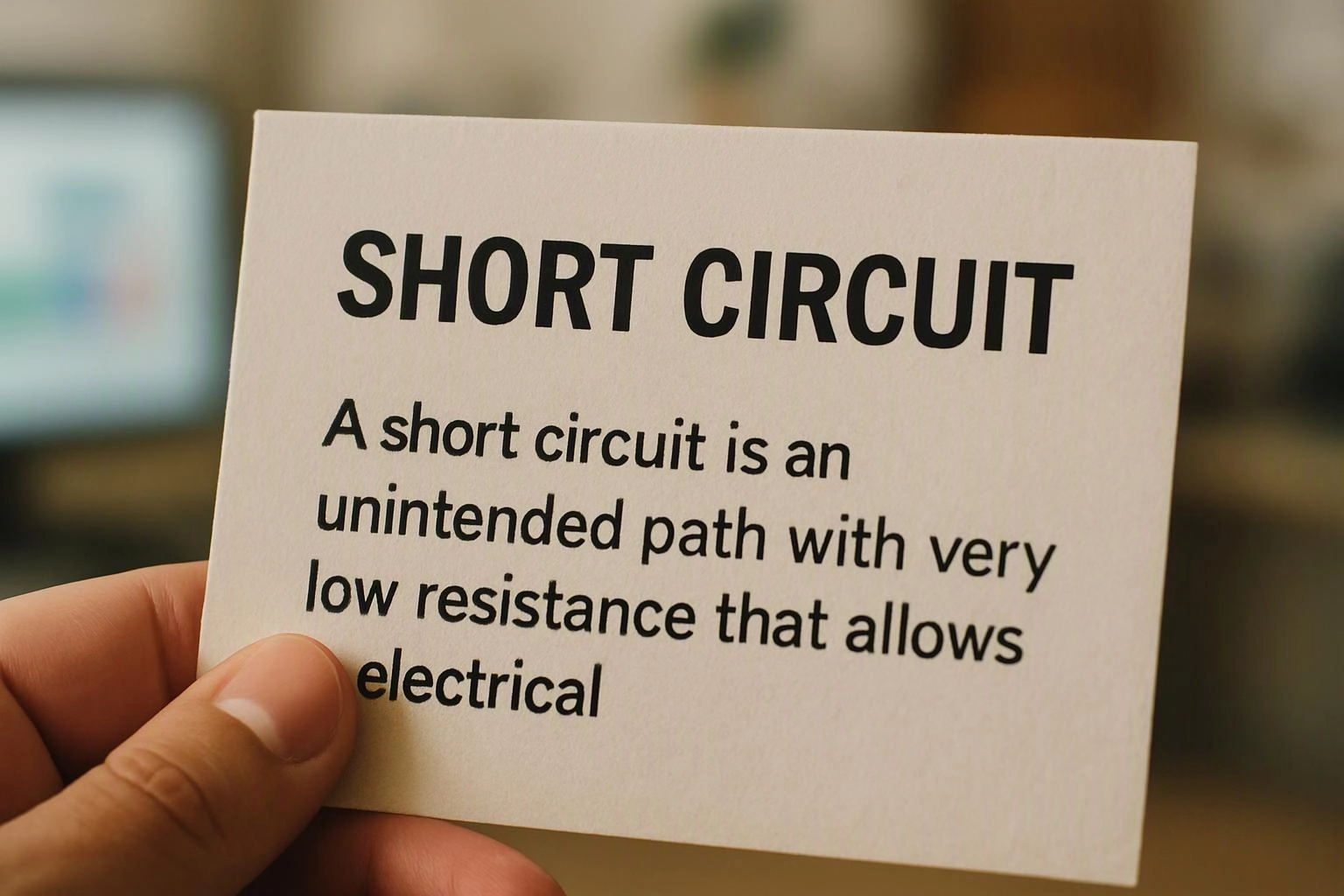
What is Short Circuit?
Short Circuit is an unintended connection between points with different electrical potential that creates a low-resistance path for current. The path allows more amperage than the circuit, wiring, or equipment can safely carry. A short circuit can trip a breaker, blow a fuse, damage components, produce heat, or start an electrical fire.
Quick Facts About Short Circuit
Category
Electrical fault
Measured by
Fault current and circuit resistance
Main risk
Fire, shock, equipment damage
Common confusion
Different from a normal overload
Also called
Electrical short, Short circuit fault
Often discussed with
Emergency Electrical Repairs, Electrical Troubleshooting
Key Takeaways About Short Circuit
- A short circuit creates an unintended path with very low electrical resistance.
- Excess current can trip a breaker, blow a fuse, or overheat wiring.
- Damaged insulation, loose connections, moisture, and faulty devices can cause shorts.
- Never repeatedly reset a tripped breaker before finding the underlying fault.
Understanding Short Circuit

Short Circuit describes an unintended electrical connection between conductors or circuit points. These points should remain separate. The connection creates a path with much less resistance than the designed load path. Under Ohm's Law, lower resistance at the same voltage permits higher current. This current can quickly stress wires, terminals, breakers, and connected equipment.
Related glossary terms: Ohm's Law, Ground-Fault Circuit Interrupter, Arc-Fault Circuit Interrupter.
A short may occur between a hot wire and neutral wire. It may occur between two ungrounded conductors. It may also occur between a hot conductor and grounded metal. Common causes include damaged insulation, loose strands, crushed cable, and incorrectly connected wiring. Other causes include water intrusion and failed appliance parts. The resulting current surge often causes an overcurrent device to open the circuit.
How Short Circuit Works, Is Measured, or Is Used?
Electrical current normally travels from a source through a planned load. It then returns to the source. A short circuit bypasses some or all of that load. The circuit impedance drops sharply. Impedance means total resistance to current flow. The available current depends on system voltage and total impedance. This includes the transformer, service conductors, branch-circuit wiring, and fault path.
Electricians evaluate a suspected fault by identifying the affected circuit. They disconnect loads and test conductors with approved instruments.multimeter can check for continuity or unexpected voltage. An insulation resistance tester can find weakened insulation when the circuit's de-energized. A fault-current calculation or available fault current label helps determine proper circuit breaker interrupting ratings.
The protective device should open before conductors reach a dangerous temperature. A breaker or fuse doesn't prevent every short, however. Its operation depends on the fault current, device rating, and grounding path. It also depends on the equipment's condition. Testing live circuits requires proper training and equipment. A fault can produce an arc, intense heat, or flying metal.
Why Short Circuit Matters?

A short circuit can damage receptacles, switches, control boards, motors, and branch-circuit wiring. The sudden current may create smoke, melted insulation, burning odors, or buzzing. It may also create visible marks near a connection. A breaker that trips right after reset often signals a continuing fault. It usually doesn't signal a temporary problem.
Protection depends on correct conductor sizing and secure terminations. It also depends on effective grounding and bonding. Properly rated overcurrent devices provide more protection.National Electrical Code addresses these installation concerns. Local inspection rules may add more requirements. Finding the cause matters because replacing a breaker won't correct the fault. The same hazard could remain in place.
When Short Circuit Matters Most?
Short circuits deserve prompt attention after water enters an electrical box. They also need attention after a cable is cut or pinched. An appliance may also cause repeated trips. Short circuits matter after remodeling, storm damage, and rodent damage. They matter after work disturbs older wiring. Warning signs include a hot outlet, discolored plastic, or crackling sounds. Other signs include a burning smell or a breaker that won't stay on.
If a fault is suspected, stop using the affected equipment. Switch off the circuit only if you can do so safely. Don't bypass a fuse or install a larger breaker. Don't keep resetting the same breaker. Emergency conditions may require circuit isolation and wiring inspection. They may also require device inspection and repairs under applicable electrical requirements.
How to Evaluate Short Circuit?
- Check whether the breaker trips immediately, only under load, or after a period of operation.
- Look for heat damage, discoloration, melted insulation, buzzing, moisture, or a burning odor.
- Confirm that replacement breakers and fuses match the circuit rating and panel listing.
- Test disconnected conductors for unintended continuity before restoring power.
- Review available fault current and the protective device interrupting rating during system work.
Related Concepts Compared
Short Circuit vs. Electrical Overload
An overload occurs when connected equipment draws more current than a circuit is designed to carry. A short circuit creates an unintended low-resistance path and can produce a much faster current surge.
Short Circuit vs. Ground Fault
A ground fault is current flowing from an energized conductor to ground or grounded metal. It is a type of fault that may involve a short circuit, but not every short circuit is a ground fault.
Short Circuit vs. Arc Fault
An arc fault involves electricity jumping across a gap or damaged connection. A short circuit may occur without a visible arc, although a high-current fault can produce an arc flash.
Short Circuit vs. Open Circuit
An open circuit has a broken or interrupted path, so current cannot flow normally. A short circuit provides an unintended path with unusually low resistance.
Expert Note
A breaker trip identifies abnormal current, not the exact failure point. The cause may be inside a device, a junction box, or concealed cable. Testing must account for stored energy, shared neutrals, backfeed, and damage that remains after the breaker opens.
Common Mistakes or Myths About Short Circuit
- Treating every breaker trip as a defective breaker.
- Replacing a fuse with a larger fuse to stop repeated trips.
- Assuming a reset breaker proves the wiring is safe.
- Ignoring warm outlets, burning odors, buzzing, or melted insulation.
- Testing energized wiring without proper training or protective equipment.
Short Circuit in Practice: A Real-World Example
A homeowner plugs in a damaged space heater, and the kitchen breaker trips at once. Inspection finds insulation damage near the heater cord, while the branch-circuit wiring remains intact. Replacing the heater and checking the receptacle resolves the immediate fault without installing a larger breaker.
Related Terms
Ohm's Law
Ohm's Law is the relationship between voltage, current, and resistance in an electrical circuit. The formula…
Ground-Fault Circuit Interrupter
Ground-Fault Circuit Interrupter is a device that monitors electrical current and quickly disconnects power when current…
Arc-Fault Circuit Interrupter
Arc-Fault Circuit Interrupter is a circuit protection device that detects dangerous electrical arcing and disconnects power…
Electrical Grounding
Electrical Grounding is a safety system that connects electrical equipment and circuits to the earth or…
Toledo Electrician
Have Questions About Short Circuit?
Contact Toledo Electrician for practical guidance on Short Circuit and related 24 hour electrician work in Toledo.