Skip to content
Glossary

What is a Voltage?

Voltage is the electrical potential difference that pushes electric charge through a circuit. Measured in volts, voltage provides the force that moves current through wires, devices, and electrical equipment. Common household circuits use about 120 volts, while larger equipment may require 240 volts or another specified supply.

Quick Facts About Voltage

Category

Electrical measurement

Formula

Voltage equals current multiplied by resistance

Measured by

Voltmeter or multimeter

Common benchmark

120 volts for many North American general-purpose receptacles

Common confusion

Voltage is not the same as amperage or wattage

Also called

Electrical potential difference, Electric potential

Key Takeaways About Voltage

  • Voltage measures the electrical pressure between two points in a circuit.
  • A voltmeter checks voltage without needing to measure current directly.
  • Higher voltage can deliver more power. But it also increases shock risk.
  • Voltage drop can reduce equipment performance when wiring is too long or undersized.
  • A device must match the voltage supplied by its circuit.

Understanding Voltage

Toledo Electrician — detail view — Understanding Voltage

Voltage describes the difference in electrical potential between two points. It acts like pressure that encourages <strongelectric charge</strong> to move through a conductive path. A circuit needs a voltage source before current can flow through a connected load. Sources include batteries, utility transformers, and generators.

Related glossary terms: Amperage, Ohm, Ohm's Law.

Voltage is measured in volts, represented by the letter V. Alternating current in many homes changes direction many times each second. Direct current from a battery moves in one direction. A device receives the voltage listed on its nameplate. That rating helps show if the device can work safely and properly.

How Voltage Works, Is Measured, or Is Used?

The relationship among voltage, current, and resistance is described by Ohm's Law. The formula is V = I × R. Here, V means voltage, I means current in amperes, and R means resistance in ohms. For example, a circuit has 10 amperes of current and 12 ohms of resistance. Its calculated voltage is 120 volts.

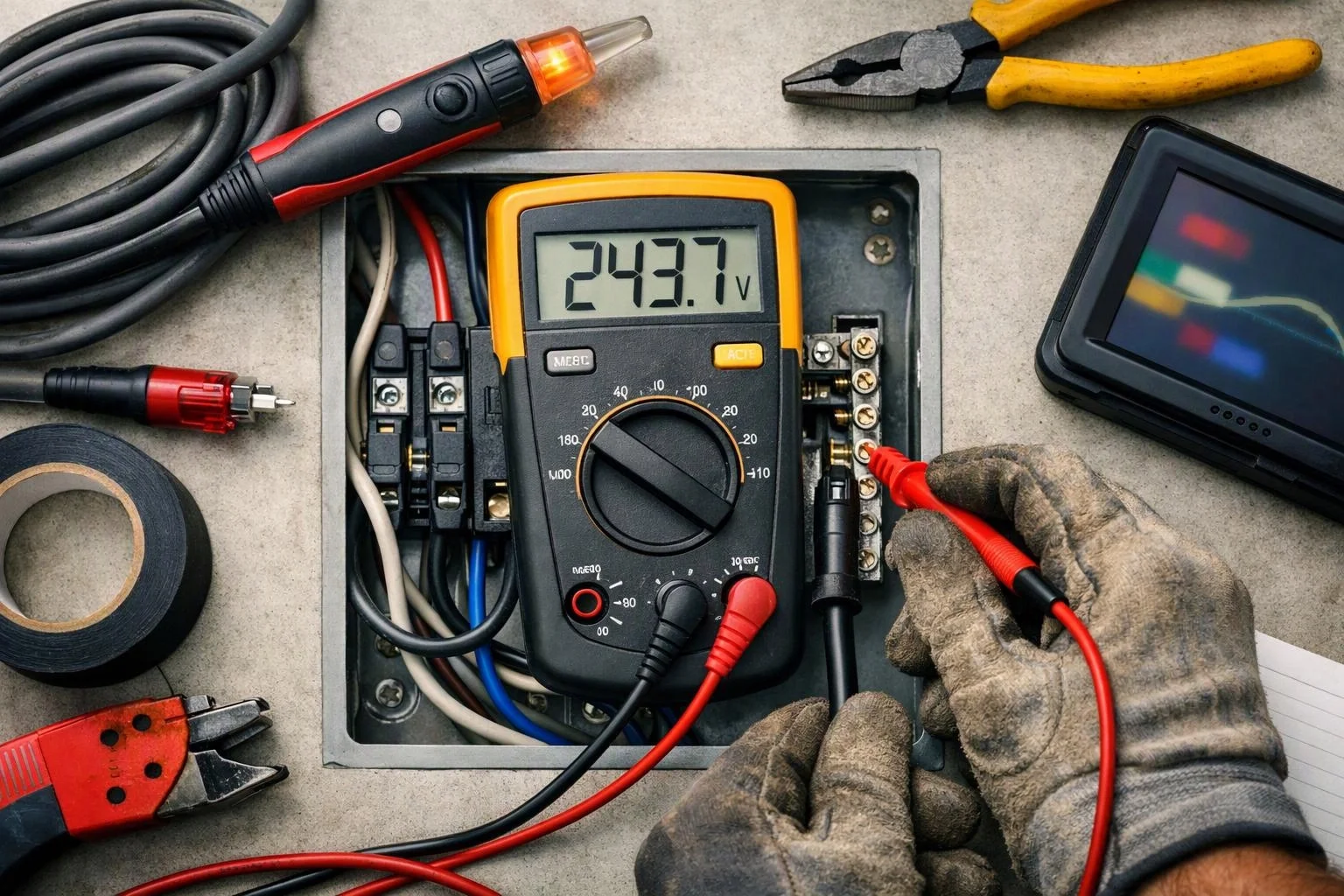
An electrician measures voltage by placing a multimeter across two points in a circuit. The meter must use the correct setting for AC or DC. It must also use the expected voltage range. A voltage reading can show whether power reaches a receptacle. It can show whether a breaker supplies a branch circuit. It can also show an unusual loss at a connection.

Voltage also affects electrical power. The basic power formula is P = V × I. A 120-volt load drawing 10 amperes uses about 1,200 watts. A circuit may have the correct voltage at the panel. It may show a lower reading at a distant load. This happens because of voltage drop in the wiring.

Why Voltage Matters?

Toledo Electrician — service highlight — Why Voltage Matters?

Correct voltage helps motors, heating elements, lighting, electronics, and controls work as designed. Too little voltage can cause dim lights, slow motors, nuisance trips, or overheating. Too much voltage can damage parts and create dangerous conditions.

Voltage also affects shock exposure and equipment selection. The risk depends on the voltage level, contact time, moisture, and body path. Don't assume a circuit's safe because a switch is off. A qualified person should check for voltage before working on conductors. They should use an appropriate tester.

When Voltage Matters Most?

Voltage becomes especially important during electrical troubleshooting, new equipment installation, and circuit changes. A technician may compare voltage at several points. These points include the service equipment, breaker, receptacle, and load. This can help find an open connection or excessive drop. Nameplate ratings must match the circuit. This ensures the equipment gets its required supply.

Voltage checks also matter after outages, storms, panel work, and generator connections. A loose neutral can create uneven voltage between circuits. This may damage appliances even when some lights still work. Warning signs include flickering lights, repeated equipment failure, warm receptacles, buzzing, or readings that vary greatly under load.

How to Evaluate Voltage?

  • Compare the measured voltage with the equipment nameplate and circuit rating.
  • Check voltage at both the source and the load when voltage drop is suspected.
  • Confirm whether the circuit supplies alternating current or direct current.
  • Inspect for flickering lights, warm connections, buzzing, or unexplained equipment damage.
  • Verify de-energization with a properly rated tester before touching conductors.

Related Concepts Compared

Voltage vs. Amperage

Amperage measures the amount of electric current flowing through a circuit. Voltage provides the electrical pressure that helps drive that current.

Voltage vs. Wattage

Wattage measures electrical power. Power depends on both voltage and current, as shown by the formula P = V × I.

Voltage vs. Voltage Drop

Voltage drop is the reduction in voltage between the power source and the connected load. Voltage is the overall potential difference measured between two points.

Voltage vs. Electrical Grounding

Electrical grounding creates a controlled path for fault current and helps stabilize a system. Grounding does not mean that voltage and current are the same measurement.

Expert Note

A voltage reading has meaning only when you know where and how it was taken. An unloaded circuit may show normal voltage while a weak connection causes a sharp drop when a motor or heater starts.

Common Mistakes or Myths About Voltage

  • Treating voltage and amperage as interchangeable terms.
  • Assuming a circuit is de-energized because a switch is off.
  • Installing equipment with a voltage rating that does not match the circuit.
  • Ignoring voltage drop on long runs or circuits with heavy loads.

Voltage in Practice: A Real-World Example

A homeowner measures 120 volts at a circuit breaker but only 105 volts at a distant receptacle while a space heater runs. The difference suggests excessive voltage drop or a poor connection that needs testing before continued use.

Related Terms

Amperage

Amperage is the amount of electric current flowing through a circuit at a given moment. Measured…

Ohm

Ohm is the SI unit of electrical resistance. One ohm describes a resistance that allows one…

Ohm's Law

Ohm's Law is the relationship between voltage, current, and resistance in an electrical circuit. The formula…

Voltage Drop

Voltage Drop is the reduction in electrical voltage that occurs as current travels through a wire…

Toledo Electrician

Have Questions About Voltage?

Contact Toledo Electrician for practical guidance on Voltage and related 24 hour electrician work in Toledo.

+1 (419) 574-6561